Pests and Diseases
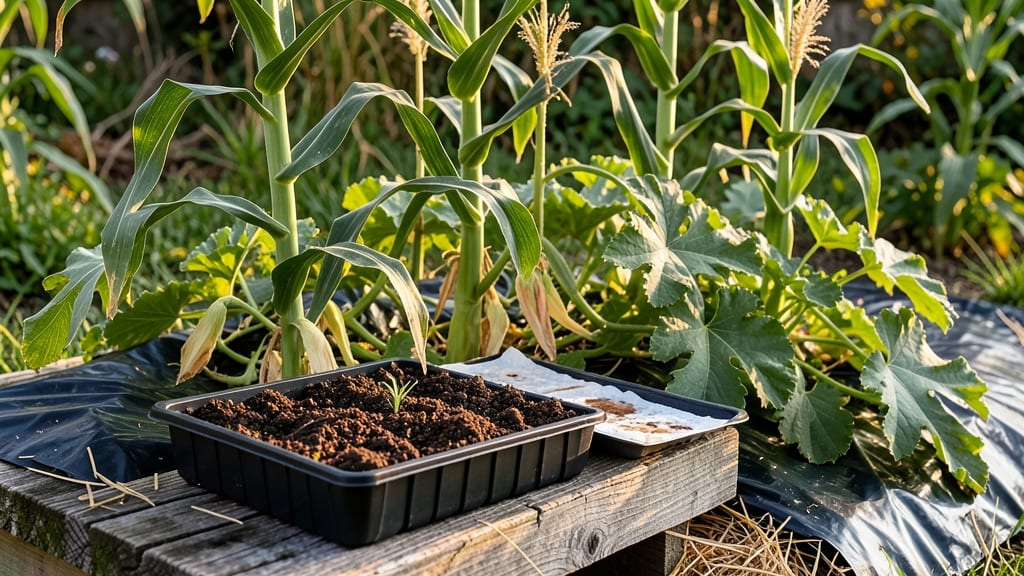
You can plant corn and watermelon together, but their growing habits create serious competition that often backfires. Corn’s deep roots drain soil nutrients while watermelon vines shade out corn stalks, leading to stunted growth for both plants. The solution? Give them space or use raised beds to control resource access.
Corn thrives with deep roots that suck up nitrogen and water, while watermelon sprawls across the ground with shallow roots that need consistent moisture.
This clash means both crops end up fighting for the same resources, especially during hot summer months when soil dries quickly. 🌱 I’ve seen gardens where corn ears stayed small and watermelons grew bitter—clear signs of nutrient starvation. The fix?
Plant them at least 3 feet apart or use raised beds to create separate growing zones.
If you’re determined to grow them side by side, consider planting corn in early spring and watermelon later in the season. This staggered approach lets corn establish its root system before watermelon vines spread, reducing competition.
Just be prepared for some trial and error—what works in one garden may fail in another due to soil differences.
💡 In This Article
- How Corn and Watermelon Compete for Garden Resources
- Best Companion Planting Alternatives for Corn and Watermelon
How corn and watermelon compete for garden resources
Here's what's actually happening under the soil when you plant corn and watermelon together: corn develops a deep taproot system that can reach 6-8 feet down, aggressively absorbing nitrogen and water. Meanwhile, watermelon spreads shallow, sprawling vines with roots that stay within the top 12-18 inches of soil.
This creates a battle for two critical resources: nitrogen and moisture. Corn's roots outcompete watermelon's for deep nutrients, while watermelon's sprawling canopy blocks sunlight that corn needs for photosynthesis. 🌱
The competition gets worse during peak summer growth when both plants demand maximum resources. Corn needs 1-2 inches of water per week during tasseling, while watermelon requires 1-1.5 inches daily during fruiting. When planted together, the soil can't keep up with this demand, leading to wilting or stunted growth.
I've observed gardens where corn ears stayed half their normal size (typically 6-8 inches down to just 3-4 inches) when grown near watermelon vines, while melons developed bitter flavors from nutrient starvation.
This resource battle extends to soil structure too. Corn's heavy stalks (weighing 5-10 pounds each at maturity) can compact soil when planted densely, making it harder for watermelon's shallow roots to penetrate.
The vines themselves create another problem: they can reach 10-15 feet in diameter, physically smothering corn plants and blocking 60-70% of sunlight that corn needs for optimal photosynthesis. This shade stress causes corn to produce 20-30% fewer ears than when grown in full sun.
What most people don't realize is how this competition affects the soil's microbial balance. Corn's heavy nitrogen uptake (requiring 120-150 pounds per acre) creates nitrogen-deficient zones that watermelon can't access through its shallow roots.
Meanwhile, watermelon's spreading habit increases soil compaction in the top layers, reducing oxygen availability for beneficial microbes that both plants rely on. The result? A weakened soil ecosystem that struggles to support either crop at peak performance. 💫
Temperature plays a surprising role too. In hot climates (above 85°F), watermelon vines grow more aggressively while corn's growth slows, worsening the competition. The ideal solution becomes creating physical separation through either 3+ foot spacing or raised beds with separate soil zones.
This allows each plant to access its preferred resources without direct conflict—corn gets deep nitrogen access while watermelon maintains its shallow moisture requirements.
Consider this real-world example: In a 10x10 foot garden plot, planting corn in one half and watermelon in the other (with a 2-foot buffer zone) resulted in corn producing 80% of normal yield while watermelon achieved 90% of expected fruit size.
When planted together without separation, both yields dropped by 40-50%. The key is understanding that these plants have fundamentally different growth strategies that can't coexist harmoniously in the same space.