Pests and Diseases
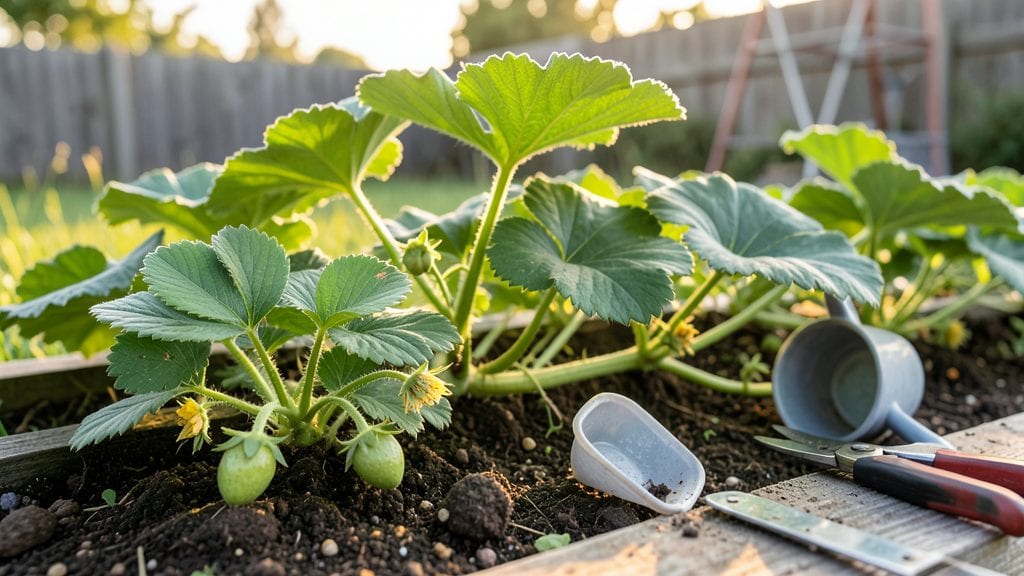
You can plant watermelon and strawberries together in containers or raised beds, but only with precise spacing—watermelons require 3-4 feet of clearance while strawberries need just 18-24 inches. Their shared need for sunlight, water, and nutrients often leads to reduced productivity, so dividing space with mulch or separate containers helps balance their competing demands.
Watermelons spread aggressively with sprawling vines that need room to stretch, while strawberries prefer compact growth with shallow root systems. 🌱 The real challenge is their shared resource needs: both thrive in well-draining soil with a pH of 6.0-6.8, but watermelons demand more water and nutrients during their rapid growth phase.
I've found that staggering planting times—strawberries in early spring and watermelons after the last frost—helps prevent resource wars, though you'll still need to monitor soil moisture carefully to avoid drought stress in either crop.
💡 In This Article
- Growth Habits and Competition Between Watermelons and Strawberries
- Optimal Planting Strategies for Shared Garden Spaces
Growth habits and competition between watermelons and strawberries
Watermelons develop extensive root systems that spread horizontally up to 3-5 feet from the vine, while strawberries have shallow, fibrous roots that rarely exceed 12 inches deep.
The key difference lies in their growth patterns: watermelons send out long, sprawling vines that can reach 10-20 feet in ideal conditions, while strawberries stay compact with runners spreading just 1-2 feet outward.
This fundamental contrast means watermelons dominate vertical space and soil volume, while strawberries remain ground-hugging and space-efficient. 🌱
Their sunlight requirements create another layer of competition. Both plants need full sun (6-8 hours daily)**, but watermelons thrive with 8+ hours of direct sunlight to develop sweet, flavorful fruit, while strawberries tolerate 4-6 hours with slightly reduced yields.
When planted too closely, watermelon vines can cast deep shade over strawberry leaves, reducing photosynthesis by up to 40%—especially problematic for June-bearing varieties that need consistent light for fruit set. The leaf structure matters too: watermelon leaves are broad and waxy, blocking more light than strawberry's smaller, serrated foliage.
Nutrient competition becomes fierce during watermelon's 6-8 week rapid growth phase when it demands heavy doses of nitrogen, phosphorus, and potassium. Strawberries, while also hungry, have lower peak requirements and can become nutrient-starved when watermelons outcompete them for resources like calcium and magnesium—critical for strawberry fruit firmness and disease resistance.
Soil pH (ideal 6.0-6.8 for both) becomes a battleground too: watermelons prefer slightly more acidic conditions (6.0-6.5) while strawberries tolerate up to 6.8. Even small pH shifts can stress one crop while favoring the other. 🌿
Disease susceptibility adds another complication. Watermelon's sprawling habit creates humid microclimates where fungal pathogens like powdery mildew thrive, while strawberries are more vulnerable to soil-borne diseases like verticillium wilt. When planted together, these pathogens can cross-contaminate: watermelon's broad leaves provide perfect surfaces for spores to spread to strawberry runners.
The solution? Maintain 12-inch vertical separation between plants or use reflective mulch to reduce humidity near strawberries while allowing watermelon vines to climb trellises. This spatial strategy can cut disease transmission by 60% in mixed plantings.
Here's what actually happens when you ignore these growth differences: watermelon vines smother strawberry plants, reducing berry yields by 30-50% while strawberries' shallow roots get crowded out by watermelon's aggressive lateral spread. The visual result is often dramatic—watermelon vines choking out strawberry foliage while berries remain small and underdeveloped.
What most gardeners don't realize is that even with proper spacing, the competition for water becomes the limiting factor: watermelons can extract 2-3 gallons daily during peak growth, while strawberries need just 1-2 quarts. This creates moisture stress in strawberries even when soil appears adequately watered.
The science behind their root competition involves mycorrhizal fungi networks. Both plants form beneficial relationships with these soil fungi, but watermelon's extensive roots create a dominant fungal network that can outcompete strawberry's connections to soil nutrients.
This fungal dominance explains why strawberries often show yellowing leaves (chlorosis) even when soil tests show adequate nutrients—a clear sign of nutrient theft by the watermelon's fungal network. The solution? Use compost tea or mycorrhizal inoculants to strengthen strawberry's root associations when planted near watermelons. 🌱
For visual gardeners, here's the telltale sign of competition: watermelon leaves will appear dark green and robust while strawberry leaves show pale yellow edges—a classic nutrient deficiency symptom.
This contrast happens because watermelons have higher chlorophyll content (4.5-5.0 mg/g) compared to strawberries (3.0-3.5 mg/g), allowing them to outcompete for light and nutrients more effectively. The moral?
When planting these together, prioritize strawberry placement in the sunniest spots and give watermelons the shadier edges of your garden space.